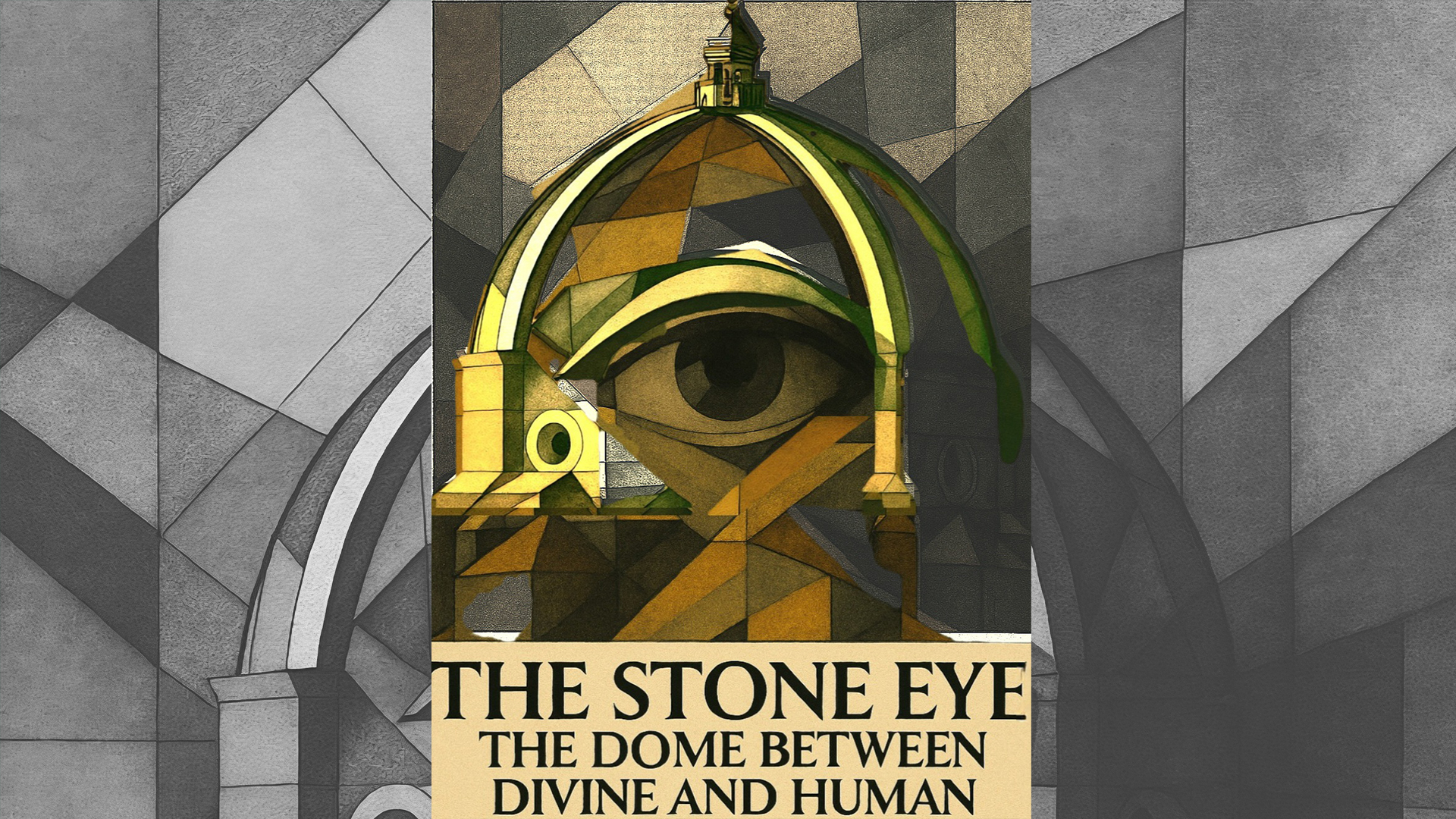
The Stone Eye
The Dome Between Divine and Human
It is well known that the theme of the dome is intimately linked to that of the eye: vision and the ability to frame a portion of space through the visual organ concern not only the artists of the Quattrocento and Cinquecento, but also the historical avant-gardes, ready to symbolically transform a culture oriented toward gravitational stasis.
Cubism challenges the frontal perspective conception, exploring the collateral spaces of inside-outside, high-low, above-below, and producing a series of mirrorings, dissolutions, and superimpositions of the primary perspective image. The multiplication of viewpoints coincides with the impossibility, or the will, to control space, a distinctive trait of a culture in full technological evolution. The new compositional canon, which influences architecture in its most organic forms, translates what pictorial experimentalism achieves in completed form.
The decomposition of the plastic planes of architectural space leads the architect to formulate a masterful question, which still today finds no definitive answer: if architecture, as a three-dimensional system, can satisfy the need to evaluate the possible ‘faces’ of a building, it must also succeed in expressing, in a single ‘facade,’ the intent of perspectival superimposition of all the constituent elements of the architectural organism.
Brunelleschi’s dome is a hypothetical eye that points toward its horizon; its pupil—the lantern—seen from within, allows the observer to peer into that inexpressible source of light and its wandering across the frescoed surface. The poetics of inside-outside and the image of the world, seen through the giant eye of the dome, are realized in the illusion of the divine observatory par excellence.
The belief that art, culture, and science had been destroyed by the northern barbarians prevailed in the minds of Italians in the Trecento, who believed in the reconquest of the past, re-proposed in a new era. The breaking of traditional style, carried out by Brunelleschi, rests on solid theoretical and design foundations, thanks to which it was possible to fulfill the goal of the Florentines: to span the immense distance between the cathedral’s pillars with the construction of the dome.
The search for a new beauty and harmony materializes in a new way of making architecture, in the freedom to use classical forms. In this case, the rejection was directed at the Gothic tradition, replaced by a personal language in which columns, pillars, and arches contributed to the exaltation of classical order. Roman architecture exerted an irresistible attraction on the artists of the Quattrocento, whose study was reserved for the infamous ‘educated classes.’
The rebirth of art, which reigned from the Quattrocento to the Ottocento, passed through various historical periods in which compositional elements were based on the imitation of Renaissance forms, themselves grounded in the mathematical norms of perspective representation. Not even the Greeks knew the mathematical rules of perspective, although they were skilled masters of the illusion provoked by depth. With Brunelleschi’s perspective, even painting is absorbed into a rigid system of mathematical rules. The Holy Trinity, with the Virgin, Saint John, and the donors, a work by Masaccio, is the revolutionary example of the era.
From "Design of New Words"
The Stone Eye by Filippo Lo Presti 1989